AI Task Automation: Your Complete Guide to Intelligent Business Transformation

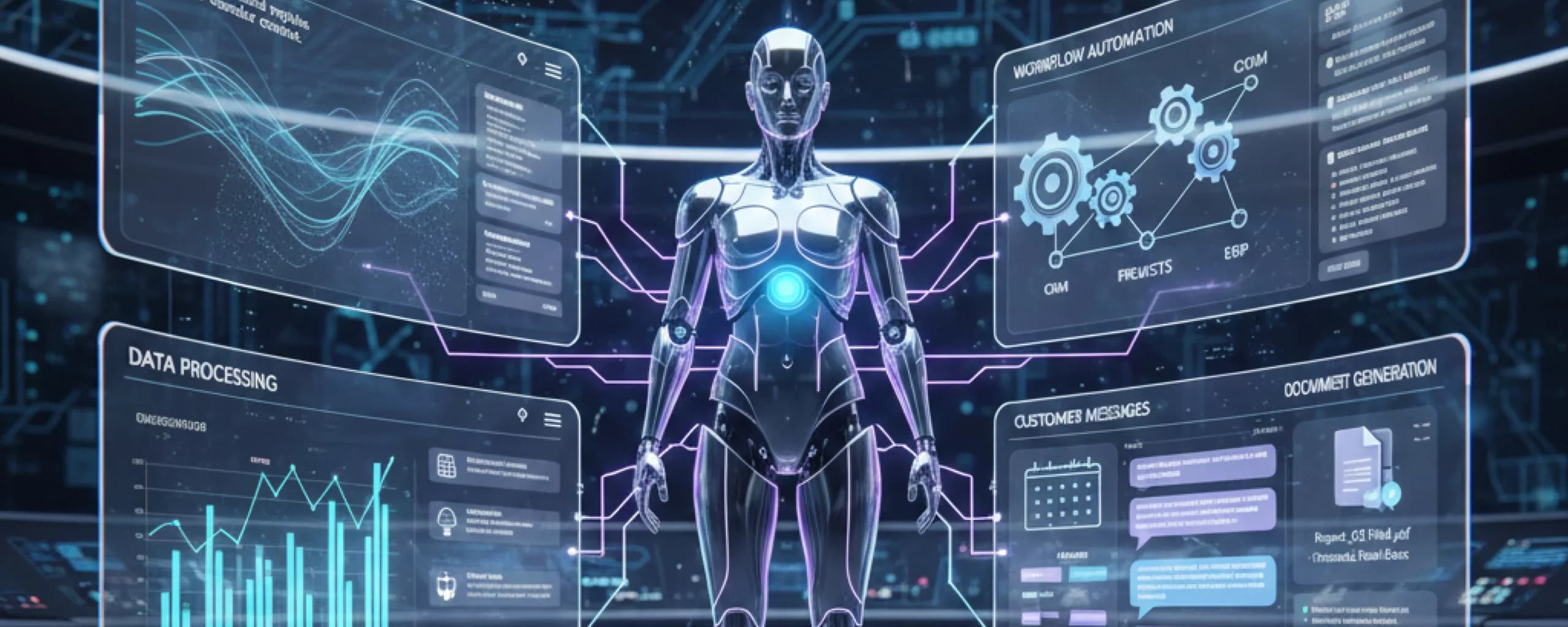
The business landscape has fundamentally shifted. While 64% of business owners believe AI will help improve customer relationships and boost productivity, many organizations still struggle with manual processes that consume valuable resources and limit growth potential. AI task automation emerges as the definitive solution, enabling businesses to streamline operations, reduce costs, and scale efficiently.
Recent research shows that 92% of early AI adopters are already seeing ROI, with many generating $1.41 in value for every dollar spent. The global business process automation market is expected to reach $16.46 billion by 2025, reflecting a compound annual growth rate of 10.7% as organizations recognize the transformative power of intelligent automation.
This comprehensive guide explores how AI task automation revolutionizes business operations, delivers exceptional ROI, and enables organizations to focus on high-value strategic initiatives while machines handle routine tasks.
Understanding AI Task Automation
AI task automation goes beyond traditional rule-based automation by incorporating artificial intelligence technologies to handle complex, variable processes that previously required human judgment. Unlike simple robotic process automation (RPA) that follows predetermined scripts, AI task automation uses machine learning, natural language processing, and intelligent decision-making to adapt to changing conditions and handle unstructured data.
At its core, AI task automation leverages advanced technologies including machine learning algorithms, natural language processing, computer vision, and predictive analytics to automate end-to-end workflows. This integration enables systems to understand context, make intelligent decisions, and continuously improve performance through experience.
According to recent surveys, 51% of organizations are adopting AI for process automation, with 75% of large enterprises expected to implement AI-powered automation in at least one business process, driving significant cost savings and efficiency improvements.
The Business Case for AI Task Automation
Exceptional Return on Investment
Organizations implementing AI task automation achieve remarkable financial returns. According to Forrester’s Total Economic Impact study, companies using advanced AI automation platforms achieve 333% ROI with $12.02 million net present value over three years. Most organizations see payback in less than six months, with immediate productivity gains including 85% reduction in review times and 65% faster employee onboarding.
Companies implementing AI in their business processes see an average cost reduction of 20%, while automating even rudimentary AI-based extraction techniques results in 30% to 40% efficiency improvements. These substantial savings stem from reduced manual labor, minimized errors, and accelerated processing times.
Operational Efficiency Gains
AI task automation delivers measurable operational improvements across multiple dimensions:
- Time Savings: Organizations typically save 5-10 hours per employee per week through automated routine tasks
- Error Reduction: AI-powered systems achieve up to 99% accuracy in data processing tasks
- Process Speed: Automated workflows complete tasks 3-5x faster than manual processes
- Scalability: Systems handle increasing workloads without proportional staff increases
Enhanced Employee Experience
By automating repetitive, mundane tasks, AI task automation allows employees to focus on higher-value activities that require creativity, strategic thinking, and human judgment. This shift improves job satisfaction, reduces burnout, and enables professional development in more meaningful areas.
Key Areas for AI Task Automation Implementation
Invoice Processing and Accounts Payable
Manual invoice handling is time-consuming and error-prone, leading to delays and increased costs. AI-driven automation extracts key data fields from invoices using optical character recognition (OCR), validates them against purchase orders or contracts, and routes them for approval automatically.
A mid-sized manufacturing firm implemented AI-powered invoice processing automation, reducing manual effort by 60% and cutting invoice approval time from 10 days to 3 days. This transformation freed finance teams to focus on strategic analysis rather than data entry.
Customer Service and Support
AI task automation transforms customer service through intelligent chatbots, automated ticket routing, and sentiment analysis. These systems handle routine inquiries, escalate complex issues appropriately, and provide consistent, 24/7 support.
Organizations using AI and automation for customer service operations see a 68% reduction in average resolution time, while maintaining high customer satisfaction scores through personalized, context-aware responses.
Data Entry and Document Processing
AI-powered document processing automates the extraction, interpretation, and processing of information from various document types. This includes processing forms, contracts, applications, and other structured or semi-structured documents that traditionally required manual review.
Intelligent Document Processing (IDP) combines AI, machine learning, and natural language processing to achieve accuracy rates exceeding 95% while reducing processing time by 70-80%.
Human Resources Operations
HR departments leverage AI task automation for resume screening, interview scheduling, onboarding workflows, and employee data management. These systems identify qualified candidates, automate scheduling coordination, and ensure consistent onboarding experiences.
Companies implementing AI in HR operations report 65% faster employee onboarding and 40% improvement in candidate quality through automated screening processes.
Email Management and Communication
AI task automation streamlines email management through intelligent filtering, automated responses, and priority classification. Systems can categorize emails, generate contextually appropriate responses, and route messages to appropriate team members.
Advanced email automation reduces response times by 60% while maintaining personalization and context relevance in all communications.
Implementation Strategies for Maximum ROI
Process Assessment and Prioritization
Successful AI task automation begins with comprehensive process assessment to identify high-impact opportunities. Focus on processes that are:
- High-volume and repetitive
- Time-consuming for employees
- Prone to human error
- Rule-based with clear decision criteria
- Currently causing bottlenecks
Prioritize automation opportunities based on potential ROI, implementation complexity, and strategic business impact. Start with “low-hanging fruit” processes that deliver quick wins while building toward more complex implementations.
Phased Implementation Approach
Adopt a gradual approach to AI task automation implementation:
- Phase 1: Pilot Projects Select manageable processes for initial automation to test technology, workflows, and change management strategies. This allows organizations to learn and refine approaches before full-scale deployment.
- Phase 2: Horizontal Scaling Expand successful automation to similar processes across different departments, leveraging lessons learned from pilot implementations.
- Phase 3: Vertical Integration Implement comprehensive automation solutions that span multiple business functions and enable end-to-end process optimization.
Change Management and Employee Adoption
Effective change management is crucial for AI task automation success. Address employee concerns about job displacement through transparent communication about how automation enhances rather than replaces human capabilities.
Invest in comprehensive training programs that help staff adapt to new technologies and understand their evolving roles in automated environments. Involve employees early in the automation journey to reduce resistance and gather valuable insights for optimization.
Advanced AI Task Automation Technologies
Natural Language Processing (NLP)
NLP technologies enable AI systems to understand, interpret, and generate human language with increasing sophistication. This capability allows automation of complex communication tasks, content creation, and document analysis that previously required human expertise.
Business applications include automated contract review, customer inquiry processing, and content generation for marketing and communications.
Machine Learning and Predictive Analytics
Machine learning algorithms enable AI task automation systems to learn from data patterns and improve performance over time. Predictive analytics capabilities allow systems to anticipate needs and proactively trigger appropriate actions.
Applications include demand forecasting, maintenance scheduling, and risk assessment that enable proactive rather than reactive business operations.
Computer Vision and Optical Character Recognition
Computer vision technologies enable AI systems to process visual information from documents, images, and videos. OCR capabilities extract text and data from scanned documents, while advanced vision systems can analyze complex visual content.
These technologies automate quality control inspections, document digitization, and visual compliance monitoring across various industries.
Robotic Process Automation Integration
AI-enhanced RPA combines traditional automation capabilities with artificial intelligence to handle more complex, variable processes. This integration enables end-to-end automation of business workflows that involve both structured and unstructured data processing.
Modern RPA platforms incorporate AI to process emails, forms, and documents while making intelligent decisions based on context and business rules.
Measuring and Maximizing AI Task Automation ROI
Effective ROI measurement requires tracking multiple metrics that capture both quantitative and qualitative benefits:
Efficiency Metrics:
- Time saved per automated task
- Processing speed improvements
- Error rate reductions
- Employee productivity gains
Financial Metrics:
- Direct cost savings from reduced manual labor
- Revenue increases from improved customer experience
- Cost avoidance through error elimination
- Return on automation investment
Quality Metrics:
- Accuracy improvements in automated processes
- Consistency of outputs and decisions
- Compliance adherence rates
- Customer satisfaction scores
ROI Calculation Framework
Calculate AI task automation ROI using the formula: (Benefits – Costs) / Costs × 100
Implementation Costs Include:
- Software licensing and platform fees
- Integration and customization expenses
- Training and change management costs
- Ongoing maintenance and support
Benefits Include:
- Labor cost reductions
- Process speed improvements
- Error elimination savings
- Revenue generation increases
Continuous Optimization
AI task automation systems improve over time through machine learning and feedback loops. Establish regular review cycles to optimize processes, update algorithms, and expand automation scope based on performance data and changing business needs.
Monitor system performance continuously and adjust parameters to maximize efficiency while maintaining quality standards. Regular optimization ensures sustained ROI growth over time.
Industry-Specific Applications
Financial Services
Financial institutions leverage AI task automation for fraud detection, loan processing, compliance monitoring, and customer onboarding. These applications reduce operational risk while improving customer experience through faster, more accurate service delivery.
Healthcare Operations
Healthcare organizations automate patient scheduling, insurance verification, medical coding, and documentation processes. AI task automation reduces administrative burden on healthcare professionals while improving accuracy and compliance.
Manufacturing and Supply Chain
Manufacturing companies implement AI task automation for inventory management, quality control, demand forecasting, and supplier coordination. These applications optimize production efficiency while reducing operational costs.
Retail and E-commerce
Retail organizations automate inventory management, customer service, order processing, and personalized marketing. AI task automation enables scalable operations that adapt to changing customer demands and market conditions.
Future Trends in AI Task Automation
Hyperautomation Evolution
Hyperautomation represents the next phase of AI task automation, involving the orchestration of multiple automation technologies to create comprehensive, intelligent business processes. This approach combines RPA, AI, machine learning, and process mining to automate complex, end-to-end workflows.
Agentic AI Development
Agentic AI systems that can plan, execute, and optimize tasks autonomously represent the future of task automation. These systems will handle increasingly complex scenarios while requiring minimal human oversight.
No-Code and Low-Code Platforms
The democratization of AI task automation through no-code and low-code platforms will enable business users to create and modify automated processes without extensive technical expertise.
Ready to Transform Your Business Operations?
The evidence is compelling: businesses implementing AI task automation achieve substantial ROI, operational improvements, and employee satisfaction gains. With proven technologies and implementation methodologies available, the question isn’t whether to automate, but how quickly you can begin realizing these benefits.
Success in AI task automation requires the right combination of technology, strategy, and execution support. Organizations that partner with experienced automation providers accelerate their transformation while minimizing implementation risks.
Transform your business operations with Isometrik AI‘s proven task automation solutions. Contact our automation specialists today to discover how intelligent automation can revolutionize your organization, reduce operational costs, and drive sustainable growth through strategic process optimization.