Examples of AI in Real Businesses: How Companies Drive Real Results with Smart Technology

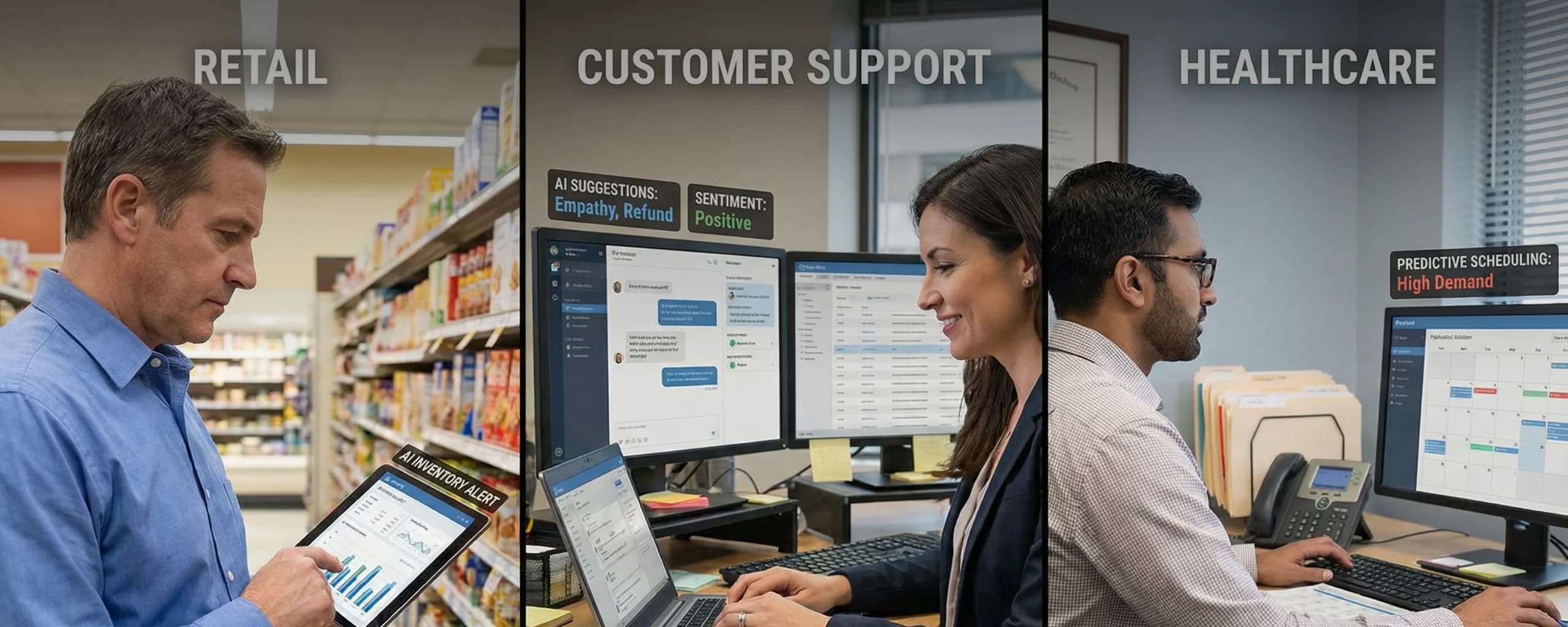
Examples of AI in real businesses are transforming how companies operate and compete. From retail giants to healthcare providers, organizations are achieving measurable returns that go far beyond experimental pilots. While 90% of companies now use AI tools regularly, only 6% achieve transformative enterprise-wide impact.
The gap between AI adoption and success isn’t about the technology. It’s about strategic implementation. Companies generating significant ROI focus on specific, high-value use cases rather than spreading efforts thin across multiple projects.
The Financial Impact: Real Numbers from AI Leaders
Companies implementing AI sales agents experience average increases of 35% in qualified leads, 25% in conversion rates, and 17% in revenue growth, with some organizations achieving 333% ROI within three years.
Among executives deploying AI agents in production, 74% report achieving ROI within the first year, while 39% see productivity gains that at least double. These aren’t theoretical projections—they’re documented results from real implementations.
With 85% of Fortune 500 companies using AI solutions and 66% of CEOs reporting measurable business benefits, the evidence is clear: AI delivers when implemented strategically.
Netflix: Personalization That Saves Billions
Netflix demonstrates how examples of AI in real businesses can create massive value through precision targeting. Their recommendation engine analyzes viewing history, behavioral patterns, and content preferences to deliver hyper-personalized experiences.
Netflix’s AI system saves over $1 billion annually in customer retention costs while boosting engagement. The platform processes user data in real-time, considering factors like viewing completion rates, time of day usage, and device preferences.
Eighty percent of content watched on Netflix comes from AI-driven recommendations. This isn’t just about entertainment—it’s about creating sticky experiences that reduce churn and maximize lifetime customer value.
The lesson for businesses: AI personalization works across industries, not just streaming. Companies applying similar behavioral analysis to their customer interactions see comparable engagement improvements.
Amazon: Supply Chain Intelligence at Scale
Amazon’s AI implementation across logistics showcases how examples of AI in real businesses can optimize complex operations. Their AI-powered recommendation system accounts for 35% of total sales, contributing to quarterly revenues exceeding $143 billion.
Beyond recommendations, Amazon uses AI for:
- Predictive inventory management
- Dynamic pricing optimization
- Route planning for delivery efficiency
- Warehouse automation
At their scale, AI improvements that save pennies per package add up to billions of dollars in cost savings. Their systems continuously analyze demand patterns, seasonal trends, and regional preferences to ensure products are available when and where customers need them.
Walmart: AI-Driven Transformation Across Operations
Walmart’s comprehensive AI strategy demonstrates how traditional retailers can compete with tech giants. The company achieved a 4.8% revenue uplift from generative-AI-driven merchandising and cut emergency maintenance costs by 30%.
Their AI applications include:
Trend-to-Product System: AI tracks social media trends and search data to generate product concepts, feeding directly into prototyping and sourcing processes.
Supply Chain Optimization: Real-time AI systems analyze traffic patterns, weather changes, and customer ordering habits to optimize delivery routes and inventory placement.
Negotiation Automation: Pactum AI achieved a 68% success rate in supplier negotiations, delivering 3% average savings on contracts.
Walmart plans to power 65% of stores with automation technologies by 2026, showing their commitment to AI-driven efficiency.
Small Business Success Stories: Proving AI Isn’t Just for Giants
Examples of AI in real businesses extend beyond Fortune 500 companies. Small and medium enterprises are achieving impressive results with targeted implementations.
E-commerce Retailer: A small e-commerce business implemented AI recommendation engines and saw average cart size increase by 15% within six weeks, achieving ROI within 45 days.
Digital Marketing Agency: By integrating AI into documentation and content creation workflows, an agency saved 8-10 hours weekly on administrative tasks and increased billable capacity by 20%.
Consulting Firm: An independent consultant implemented an AI meeting assistant that reduced meeting minute drafting time by 75% while standardizing report quality.
These examples prove that AI success doesn’t require massive budgets or technical teams. Strategic tool selection and clear use case focus deliver measurable returns for businesses of all sizes.
Healthcare: AI Transforming Patient Outcomes
Healthcare represents one of the most impactful examples of AI in real businesses. The global AI healthcare market reached $20.9 billion in 2024 and projects growth to $48.4 billion by 2029.
Medical Diagnostics: AI diagnostic systems achieve 94% accuracy in detecting eye diseases, scanning thousands of patients weekly faster than human doctors.
Administrative Efficiency: Acentra Health’s MedScribe solution saved 11,000 nursing hours and nearly $800,000 while achieving 99% approval rates for AI-generated medical letters.
Process Optimization: Healthcare providers use AI for appointment scheduling, treatment protocol recommendations, and resource allocation, reducing wait times and improving patient satisfaction.
Financial Services: Security and Efficiency Combined
Banks and financial institutions deploy AI for fraud detection, risk assessment, and customer service optimization. The AI fintech market grew from $42.83 billion in 2023 to $44.08 billion in 2024, with projections exceeding $50 billion by 2029.
Fraud Prevention: Real-time transaction analysis identifies suspicious patterns instantly, protecting customers while maintaining smooth payment processing.
Customer Service: Stream handles over 80% of internal customer inquiries using AI models, answering questions about pay dates, balances, and account details.
Risk Assessment: AI analyzes multiple data sources to provide more accurate credit scoring and loan approval decisions.
Key Success Factors: What Makes AI Implementations Work
Analyzing examples of AI in real businesses reveals consistent patterns among successful implementations:
Clear Problem Definition: High-performing organizations focus on specific business challenges rather than experimenting with AI for its own sake.
Data Infrastructure: Successful companies invest in robust data collection and processing capabilities before deploying AI solutions.
Executive Sponsorship: Organizations achieving significant AI value commit over 20% of their digital budgets to AI technologies.
Workflow Integration: Half of AI high performers redesign workflows to maximize technology benefits rather than adding AI to existing processes.
Measurement Framework: Companies track specific KPIs and attribute results directly to AI implementations rather than relying on general productivity improvements.
Implementation Roadmap: Turning Examples into Action
Based on successful examples of AI in real businesses, follow this strategic approach:
Phase 1: Identify High-Impact Use Cases (Weeks 1-4)
- Analyze current pain points and inefficiencies
- Prioritize processes with clear ROI potential
- Assess data availability and quality
Phase 2: Pilot Implementation (Weeks 5-16)
- Start with one specific use case
- Set measurable success criteria
- Gather user feedback and refine approach
Phase 3: Scale and Optimize (Weeks 17-26)
- Expand successful pilots to broader operations
- Integrate AI tools with existing systems
- Train teams on new workflows and capabilities
Phase 4: Enterprise Integration (Months 7-12)
- Deploy AI across multiple business functions
- Establish governance and quality controls
- Plan for continuous improvement and expansion
The Future of AI in Business: Agentic Intelligence
The shift from traditional AI tools to agentic systems represents the next evolution, with 52% of organizations now deploying AI agents that handle complex workflows with minimal human oversight.
Agentic AI systems can:
- Understand complex business objectives
- Break down tasks into executable steps
- Coordinate multiple AI technologies
- Adapt to changing conditions autonomously
Companies implementing agentic solutions report higher success rates and faster deployment timelines compared to traditional AI projects.
Partnering for AI Success
While examples of AI in real businesses prove the technology’s potential, implementation complexity requires expertise. Organizations achieve faster ROI when working with experienced AI partners who understand both technical capabilities and business requirements.
At Isometrik AI, we specialize in translating successful AI patterns into custom solutions for your specific industry and challenges. Our team has helped companies across sectors achieve measurable results through strategic AI implementation.
Whether you’re looking to optimize customer experiences, streamline operations, or unlock new revenue opportunities, we provide the expertise and support needed to turn AI potential into business reality.
Contact us to explore how AI can transform your operations and drive measurable growth.