Generative AI Use Cases: Transforming Business Operations

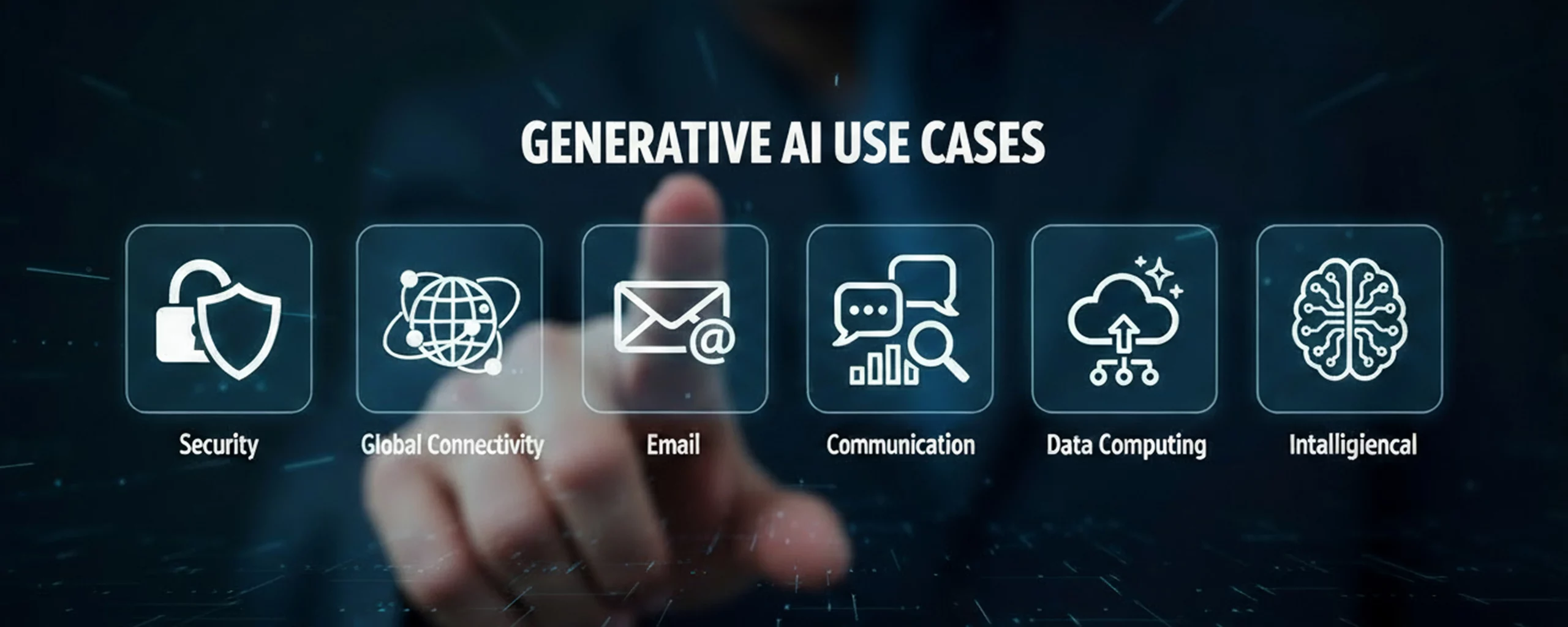
Generative AI use cases are reshaping how businesses operate across every major industry. From automating document workflows in legal firms to personalizing customer experiences in retail, this technology delivers measurable impact. Companies implementing AI solutions enhance productivity by 20-55%, making it impossible to ignore.
What makes these generative AI use cases particularly compelling is their versatility. Unlike traditional automation that handles repetitive tasks, AI generates entirely new content, insights, and solutions. It creates legal contracts, designs marketing campaigns, writes code, and predicts customer behavior with remarkable accuracy.
Approximately 85% of healthcare organizations are exploring or implementing AI capabilities, while 75% of banking leaders have deployed solutions. This isn’t experimental anymore – it’s strategic necessity.
Understanding Generative AI Applications in Modern Business
Generative AI use cases span far beyond simple chatbots. These applications leverage LLMs trained on vast datasets to produce original content across multiple formats. Like an highly intelligent assistant that never tires, processes information instantly, and generates solutions based on patterns learned from millions of examples.
The technology excels at NLP, enabling it to understand context and generate human-quality responses. This transforms how businesses handle everything from customer service to complex data analysis. Organizations deploy these to automate knowledge work, enhance decision-making, and create personalized experiences at scale.
Key capabilities include:
- Creating original written content tailored to specific contexts
- Analyzing unstructured data to extract actionable insights
- Generating code and automating software development tasks
- Producing images, designs, and multimedia content
- Personalizing customer interactions based on behavioral data
- Predicting outcomes through pattern recognition
- Automating complex, multi-step workflows
| Business Function | Primary AI Application | Expected Productivity Gain |
| Content Creation | Automated writing and design | 30-50% |
| Customer Service | Intelligent chatbots | 25-40% |
| Data Analysis | Insight generation | 35-55% |
Generative AI Use Cases Revolutionizing the Legal Sector
Legal professionals spend countless hours on document review, research, and drafting – tasks perfectly suited for AI automation. Generative AI use cases in legal work streamline operations while maintaining the precision this field demands.
Contract analysis demonstrates AI’s transformative potential. Systems scan thousands of documents, identifying key clauses, obligations, and potential risks in minutes rather than days. Law firms report saving 60-80% of time previously spent on initial document review, allowing attorneys to focus on strategy and client relationships.
Legal research acceleration:
- Analyzing case law across multiple jurisdictions simultaneously
- Generating comprehensive legal memos with relevant citations
- Identifying precedents and patterns humans might miss
- Summarizing complex regulatory changes
- Drafting initial versions of contracts and agreements
Due diligence processes that once required, now run partially automated. AI examines contracts, extracts critical information, and flags inconsistencies. This doesn’t replace legal expertise – it amplifies it, enabling lawyers to handle larger caseloads.
Compliance monitoring represents another high-value application. Regulations constantly evolve, and staying current across jurisdictions challenges even large firms. AI systems track regulatory changes, update internal policies, and alert teams to compliance requirements affecting clients.
| Legal Task | Traditional Time | AI-Assisted Time |
| Contract Review | 4-6 hours | 45-60 minutes |
| Legal Research | 3-5 hours | 30-45 minutes |
| Document Drafting | 2-3 hours | 20-30 minutes |
Tools like CoCounsel and Harvey AI automate routine legal work while maintaining client data security. These platforms don’t send information to public models for training, addressing confidentiality concerns that previously limited AI adoption in law.
Transforming E-commerce Through Generative AI Solutions
E-commerce businesses leveraging generative AI use cases gain significant competitive advantages. The technology personalizes shopping experiences at scale, automates content creation, and optimizes operations – all critical for success in crowded digital marketplaces.
Product description generation exemplifies practical AI application. Retailers with thousands of SKUs need unique, SEO-optimized descriptions for each item. AI creates these in minutes, incorporating product specifications, customer review insights, and search keywords.
Personalization capabilities:
- Generating unique product recommendations for each visitor
- Creating dynamic landing pages based on browsing behavior
- Adjusting pricing strategies in real-time
- Customizing email campaigns to individual preferences
- Designing product displays tailored to customer segments
Visual content creation accelerates dramatically with AI. Platforms generate lifestyle images, remove backgrounds, resize graphics for different channels, and even create video content from product photos.
Inventory management improves through predictive AI that analyzes sales data, seasonal trends, and market conditions. Retailers report 20-30% improvements in inventory efficiency after implementation.
| E-commerce Function | AI Impact | Business Benefit |
| Content Generation | 70% faster production | Lower marketing costs |
| Personalization | 15% higher conversion | Increased revenue |
| Inventory Forecasting | 25% better accuracy | Reduced waste |
Conversational shopping assistants guide customers through purchasing decisions. These AI agents understand natural language, answer product questions, compare options, and complete transactions.
Amazon and Walmart already deploy these systems, reporting measurable increases in customer satisfaction and sales.
SaaS Innovations Powered by Generative AI Technology
Generative AI use cases in SaaS transform how software companies build products and serve customers. The technology enables rapid feature development, intelligent automation, and personalized user experiences that were previously impossible.
Code generation accelerates software development significantly. AI assists developers by writing functions, debugging errors, and suggesting optimizations. GitHub Copilot users report productivity improvements up to 55%, allowing teams to ship features faster while maintaining code quality.
Development enhancements:
- Automated code completion and generation
- Real-time error detection and fixes
- Legacy code modernization and translation
- Documentation generation from code
- Test case creation and validation
- API integration recommendations
Customer support automation changes how SaaS companies handle inquiries. AI-powered chatbots resolve common issues instantly, escalate complex problems appropriately, and provide 24/7 availability. This reduces support costs while improving response times and user satisfaction.
| SaaS Application | Traditional Approach | AI-Enhanced Approach |
| Feature Development | 2-3 months | 3-4 weeks |
| Customer Support | 12-hour response | Instant resolution |
| Data Analysis | Requires specialists | Self-service insights |
Content creation for marketing scales effortlessly with AI. SaaS companies generate blog posts, social media content, email campaigns, and landing pages in minutes.
Recruitment Revolution: Generative AI Use Cases in HR
Hiring teams face overwhelming candidate volumes and time-consuming administrative work. Generative AI use cases in recruitment address these challenges while reducing bias and improving candidate quality. Organizations report 20-40% faster hiring cycles after implementation.
Resume screening represents the most immediate value. AI analyzes applications against job requirements, ranking candidates by fit. This happens instantly for thousands of applicants, identifying qualified candidates who might otherwise be overlooked.
Recruitment automation:
- Writing compelling job descriptions optimized for search
- Screening resumes and extracting relevant qualifications
- Matching candidates to roles based on skills and experience
- Scheduling interviews and coordinating calendars
- Generating interview questions tailored to positions
- Summarizing candidate interactions for hiring teams
Interview intelligence transforms evaluation processes. AI takes notes during video conversations, capturing key responses without human bias. Recruiters review transcripts afterward, asking follow-up questions based on actual candidate statements rather than potentially flawed memories.
| Hiring Stage | Manual Time | AI-Assisted Time |
| Resume Review | 20-30 minutes per candidate | 2-3 minutes per candidate |
| Interview Scheduling | 45-60 minutes | 5-10 minutes |
| Candidate Communication | 15-20 minutes | 1-2 minutes |
Diversity initiatives benefit from AI that removes identifying information during initial screening. This focuses evaluation on qualifications and experience, reducing unconscious bias. Organizations implementing these tools report more diverse candidate pools and hires.
Healthcare Transformation Through Generative AI Applications
Generative AI use cases in healthcare address critical challenges including administrative burden, diagnostic accuracy, and personalized treatment. The technology shows remarkable potential while requiring careful implementation.
Clinical documentation consumes significant physician time, contributing to burnout. AI listens to patient conversations and automatically generates structured notes in SOAP format. Doctors review and finalize these notes in minutes now.
Medical applications:
- Automating medical record transcription and coding
- Analyzing medical images for diagnostic support
- Generating patient education materials in plain language
- Predicting disease progression based on health data
- Designing personalized treatment plans
- Accelerating drug discovery through molecular generation
Diagnostic support systems analyze patient data, medical imaging, and clinical literature to suggest possible diagnoses. While physicians make final decisions, AI identifies patterns and connections that enhance accuracy. Studies show these tools improve diagnostic precision in complex cases.
Drug discovery accelerates dramatically with AI designing novel molecular structures. Traditional development takes 10-15 years; AI reduces timelines by generating and testing thousands of compounds virtually. Approximately 70 drugs developed with AI assistance entered clinical trials by 2024.
| Healthcare Function | Time Saved | Quality Improvement |
| Clinical Documentation | 2-3 hours daily | Higher accuracy |
| Diagnostic Analysis | 40-60% reduction | Better outcomes |
| Drug Discovery | 3-5 years | More candidates |
Administrative efficiency gains extend beyond documentation. AI handles insurance pre-authorization, appointment scheduling, and patient communications. This reduces overhead costs while allowing staff to focus on direct patient care and complex cases requiring human judgment.
Banking Sector Innovation With Generative AI Solutions
Financial institutions leverage generative AI use cases to enhance security, personalize services, and streamline operations. Banks implementing these solutions report 12% average productivity increases across customer service, compliance, and lending functions.
Fraud detection capabilities demonstrate AI’s analytical power. Systems analyze transaction patterns in real-time, identifying anomalies that indicate potential fraud. This proactive approach enables banks to prevent losses while reducing false positives that frustrate legitimate customers.
Financial services applications:
- Real-time fraud detection and prevention
- Automated credit risk assessment
- Personalized wealth management recommendations
- Regulatory compliance monitoring and reporting
- Customer service chatbot interactions
- Financial document analysis and summarization
Credit assessment processes become faster and more accurate. AI evaluates borrower creditworthiness using diverse data sources beyond traditional credit scores. This creates more comprehensive financial profiles, enabling better lending decisions while expanding access for underserved populations.
Personalized financial advice scales through AI assistants. These tools analyze spending patterns, investment goals, and market conditions to generate tailored recommendations. Morgan Stanley deployed an AI assistant supporting financial advisors by providing instant access to research and data.
| Banking Operation | Manual Processing | AI-Enabled Processing |
| Fraud Investigation | 30-45 minutes | 2-3 minutes |
| Loan Application | 3-5 days | 24-48 hours |
| Customer Inquiry | 10-15 minutes | Instant resolution |
Regulatory reporting automation reduces compliance burden significantly. AI generates required reports by extracting data from multiple systems, ensuring accuracy while freeing compliance teams for strategic risk management.
Strategic Implementation of Generative AI Across Operations
Successfully deploying generative AI use cases requires strategic planning beyond selecting technology. Organizations must address data quality, change management, and governance to realize promised benefits while managing risks.
Start with high-value, low-risk applications that deliver quick wins. This builds organizational confidence and demonstrates ROI before tackling complex implementations. Many companies begin with customer service chatbots or content generation before expanding to mission-critical systems.
Implementation priorities:
- Assessing existing data quality and accessibility
- Identifying processes with highest automation potential
- Establishing clear governance and oversight frameworks
- Training teams on AI capabilities and limitations
- Monitoring performance and refining applications
- Scaling successful pilots across operations
Data preparation determines success more than algorithm selection. AI requires clean, structured, complete datasets for training. Organizations must invest in data infrastructure before expecting meaningful results. This pays dividends across all future AI initiatives.
Teams need training not just on using AI tools but understanding their capabilities and limitations. Success requires cultural shifts embracing human-AI collaboration rather than viewing technology as replacement.
| Implementation Phase | Timeline | Key Activities |
| Assessment & Planning | 1-2 months | Use case identification |
| Pilot Development | 2-3 months | Build and test solutions |
| Scaling | 6-12 months | Expand across operations |
Governance frameworks ensure responsible AI deployment. This includes monitoring for bias, maintaining data privacy, ensuring transparency, and establishing accountability. Regulatory compliance becomes increasingly important as governments develop AI-specific regulations.